
Power Options
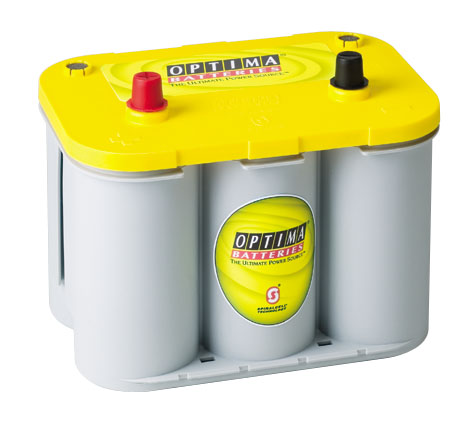 AGM batteries are just like flooded lead acid batteries, except the electrolyte is held in the glass mats, as opposed to freely flooding the plates. Very thin glass fibers are woven into a mat to increase surface area enough to hold sufficient electrolyte on the cells for their lifetime. The fibers that compose the fine glass mat do not absorb nor are affected by the acidic electrolyte they reside in. These mats are wrung out 2–5% after being soaked in acids, prior to manufacture completion and sealing. The AGM battery can now accumulate more acid than is available, and never spill a drop.
The plates in an AGM battery may be any shape. Some are flat, others are bent or wound. AGM batteries, both deep cycle and starting, are built in a rectangular case to BCI battery code specifications. Optima Battery builds a patented cylindrical AGM series of batteries that are fashioned to fit the same BCI battery size specifications as any other battery.
[edit] Comparison with flooded lead–acid cells
Compared with flooded lead–acid cells, VRLA batteries offer several advantages. The battery can be mounted in any position, since the valves only operate on overpressure faults. Since the battery system is designed to be recombinant and eliminate the emission of gases on overcharge, room ventilation requirements are reduced and no acid fume is emitted during normal operation. The volume of free electrolyte that could be released on damage to the case or venting is very small. There is no need (nor possibility) to check the level of electrolyte or to top up water lost due to electrolysis, reducing inspection and maintenance.[3]
Compared to flooded batteries, VRLA batteries are more sensitive to high temperature environments and more vulnerable to thermal run-away during abusive charging conditions.[1] VRLA batteries also have higher charge efficiency, flooded cells convert 15–20% of the electrical energy into heat instead of potential power. Gel-cells lose 10–16% but AGMs as little as 4%. While flooded cells lose up to 1% per day due to self-discharge, VRLAs lose 1–3% per month.
SHARE THIS ARTICLE


